I.Background and Context
Asthma is a chronic respiratory condition and a leading cause of childhood morbidity in the United States, affecting approximately 6.5% of children (Akinbami et al., 2016). Prevalence and severity vary by demographic, socioeconomic, and environmental factors, with children from racial and ethnic minority backgrounds and lower socioeconomic positions bearing a disproportionate burden (Keet et al., 2015; Patti et al., 2024). Outdoor air pollutants — including ozone (O₃), fine particulate matter (PM2.5, PM10), oxides of nitrogen (NOx), Volatile Organic Compounds (VOCs), and sulfur dioxide (SO₂) — are established triggers of asthma exacerbation and have been linked to new-onset disease (Brauer et al., 2024; Guarnieri & Balmes, 2014; WHO, 2021).
Exposure-response analyses have demonstrated that even modest reductions in ambient pollution may significantly lower pediatric exacerbation rates (Huang et al., 2021; Khreis et al., 2017). Indoor exposures such as secondhand smoke, gas cooking, mold, and inadequate ventilation further compound risk, particularly in low-income households (Patti et al., 2024). Despite this convergent evidence, most environmental epidemiology studies assess outdoor and indoor exposures independently, failing to capture the total exposure burden experienced by a child across multiple microenvironments throughout the day. No prior work has operationalized a single, portable, time-weighted composite index that combines ambient pollutant surfaces with household-level indoor exposures and temporal weighting for pediatric asthma research.
II.Project Description and Objectives
This thesis is embedded within the BREATHE-CC (Bridging Respiratory Exposures, Asthma, and Environmental Health — Corpus Christi) Study, a prospective pediatric respiratory health cohort developed by the Melaram Lab at Texas A&M University-Corpus Christi and based at Driscoll Children’s Hospital in Corpus Christi, Texas. BREATHE-CC follows children with asthma through monthly surveys, electronic health record (EHR) abstraction, and geospatial environmental monitoring to understand how household conditions, ambient air pollution, and social determinants of health shape respiratory outcomes in a predominantly Hispanic coastal community.
As part of our prior BREATHE-CC work, we have already characterized the geospatial exposure landscape (PM2.5, O₃, SO₂, and VOCs) of the Texas Coastal Bend region since 2016, providing the established geocoding and environmental framework upon which this thesis builds.
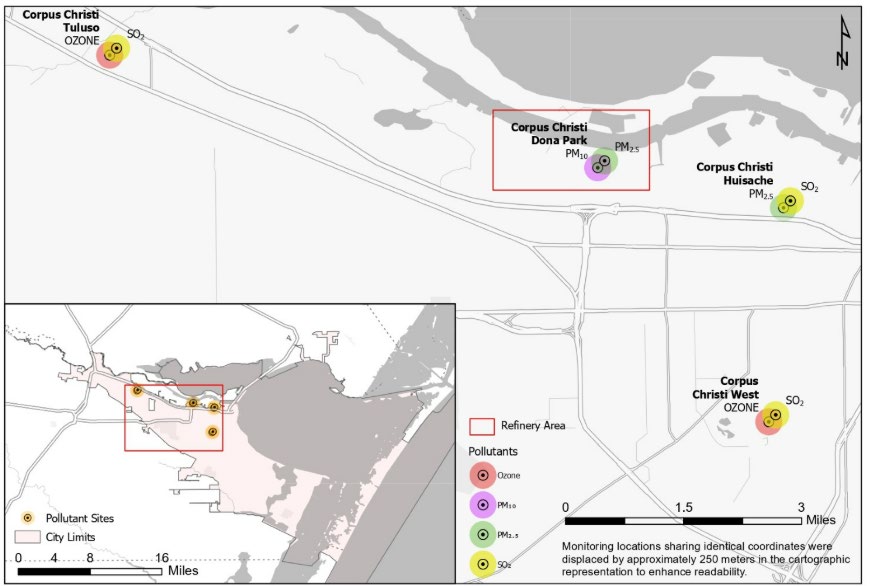
The thesis pursues two interlocking aims:
Aim 1Develop and Validate an Integrated Exposure Index (IEI)
I will create a weighted composite exposure metric integrating outdoor exposures (residential proximity to highways and industrial zones; ambient PM2.5, PM10, O₃, SO₂ from TCEQ/EPA stations) with indoor household exposures from BREATHE-CC surveys (secondhand smoke, gas cooking, mold/dampness, ventilation quality, pet allergens). For children in multi-household custody or in school/daycare, exposures will be time-weighted across exposure locations using existing percentage-of-time variables collected in the cohort. The IEI will be validated through sensitivity analyses (varying weighting schemes, spatial interpolation methods) and comparison against single-pollutant models.
Aim 2Test IEI Associations with Pediatric Asthma Outcomes
Using available BREATHE-CC data, I will examine the IEI’s independent associations with (a) monthly asthma exacerbation frequency, (b) Childhood Asthma Control Test (C-ACT) scores, and (c) wheezing phenotype trajectories identified via Group-Based Trajectory Modeling (Warden et al., 2025). Models will adjust for sociodemographic covariates including household income, parental education, insurance status, housing tenure, food insecurity, and other established demographic variables. The analysis pipeline will be built as a reproducible, documented codebase so it can be rerun on the full BREATHE-CC cohort once data collection is finalized.
Note on scope: An earlier version of this proposal included the development of a Neighborhood Completeness Index (NCI) and testing the NCI × IEI interaction as an effect modifier of asthma outcomes. Following discussion with the thesis sponsor, the scope was refined to focus on the IEI in depth rather than pursuing breadth across two indices. The NCI remains a viable extension for future work and may be pursued post-thesis or as time permits.
Novelty, Significance, and Research Gap
It is important to distinguish the contributions of this thesis from the existing scope of the BREATHE-CC Study. BREATHE-CC is designed as a prospective data-collection infrastructure: it recruits pediatric asthma patients, administers baseline and monthly surveys, abstracts electronic health record data, and monitors local ambient air quality. This study plans to leverage this existing structure by creating unique indices from the existing data and test a novel hypothesis through these indices. BREATHE-CC does not include the construction of a Neighborhood Completeness Index, does not compute an Integrated Exposure Index, and has no current plans to test interaction effects between neighborhood-level constructed-environment factors and environmental exposures on respiratory outcomes. These analytical constructs and the questions they aim to address are entirely original contributions proposed by this thesis.
The significance of this work is twofold:
(1) It addresses a well-documented gap in the pediatric environmental health literature. Outdoor air pollutants and childhood asthma have been extensively studied in isolation: a systematic review and meta-analysis of 41 studies demonstrated significant associations between traffic-related air pollutants (PM2.5, NO₂, black carbon) and childhood asthma development (Khreis et al., 2017), and a large multi-cohort analysis found that early-life PM2.5 and NO₂ exposure increased asthma incidence, with heightened risk among minoritized families in under-resourced communities (Zanobetti et al., 2024). Indoor exposures have similarly been linked to respiratory disease independently: meta-analytic evidence shows gas cooking increases childhood asthma risk by 32% (Lin et al., 2013), an estimated 12.7% of U.S. childhood asthma is attributable to gas stove use (Gruenwald et al., 2023), and household mold and dampness exposure in early life elevates asthma risk by 39% (Tischer et al., 2011). While exposomics frameworks have called for integration of indoor and outdoor exposures (Pajewska-Szmyt et al., 2025), and statistical mixture methods have modeled joint pollutant effects on childhood asthma (Alcala et al., 2024; Hu et al., 2024), no prior work has operationalized a single, portable, time-weighted composite index that combines ambient pollutant surfaces with household-level indoor exposures for pediatric asthma research; the IEI will attempt to fill this methodological gap.
(2) The methodological tools this thesis will produce — the IEI weighting framework, the reproducible analysis pipeline, and the validation methodology — are designed to be reusable and transferable. Future cohort studies beyond BREATHE-CC can adopt the IEI framework to conduct more comprehensive exposure analyses wherever simultaneous indoor and outdoor exposure data are collected. Beyond research, the IEI has practical applications for informing public health policy and directing environmental justice interventions in underserved communities. Additionally, this thesis provides novel insight into a severely underrepresented population in environmental health research despite bearing disproportionate exposure burden (Jin & Melaram, 2025).
III.Disciplinary Grounding
The following disciplines operate at the core of this study’s methodology and conceptualization. Figure 2 gives a graphical representation of the interdisciplinary framework that this thesis is rooted in.
Environmental and Public Health Epidemiology: The study design, exposure assessment (Inverse Distance Weighting, time-weighted averages), and outcome modeling (Group Based Trajectory Modeling, Generalized Additive Models, Poisson regression) derive from environmental epidemiological methods (Guarnieri & Balmes, 2014).
Medical Anthropology and Community Health: Medical anthropology provides the interpretive framework that makes environmental exposure biologically and socially meaningful: it grounds the IEI in an ecological and biocultural model of health, in which household conditions, neighborhood infrastructure, and everyday social context are understood as pathways through which place becomes embodied in a child's respiratory biology. Dr. Brown's expertise in community health and the social ecology of health disparities affecting racial and ethnic minority communities provides the theoretical foundation for interpreting how socioeconomic status, housing instability, multigenerational living, and food insecurity mediate environmental exposure and health.
Geospatial Science: Geocoding, proximity analysis, buffer calculations, and spatial interpolation of pollutant concentrations draw on geographic information science. The AI-powered workflow to compute NCI from coordinate inputs requires applied GIS methodology.
Data Science and Mathematics: The automated pipeline for NCI computation, weighted composite indexing, and integration of heterogeneous data sources (surveys, air quality monitoring, geospatial databases, EHRs) require computational approaches including API integration, workflow automation, and statistical programming in SAS and R.
Biochemistry and Clinical Medicine: Mechanistic understanding of how environmental pollutants interact with biological systems — oxidative stress, signal transduction cascades, immune dysregulation — allows exposure–outcome associations to be interpreted within a biochemical framework rather than a purely statistical one.
IV.Interdisciplinary Justification
This project cannot be housed within a single department at Rollins College for several reasons. First, the research question itself sits at a disciplinary intersection: asking how integrated environmental exposure — spanning indoor household conditions and outdoor ambient pollution — relates to childhood asthma requires combining epidemiological exposure assessment with anthropological understandings of how lived environments shape health. Neither discipline alone frames this question in this way.
The methods employed are also multi-disciplinary. The IEI requires environmental epidemiology for exposure characterization, geospatial science for spatial interpolation, data science for pipeline construction, and medical anthropology for contextualizing findings within the social determinants of health experienced by a predominantly Hispanic, coastal, petrochemical-adjacent community.
Furthermore, Rollins College does not have an established public health department in the College of Liberal Arts. My thesis advisor, Dr. Shan-Estelle Brown, is housed in Anthropology and directs the Global Health minor, but my thesis is not eligible to be coded under a minor-only program. BREATHE-CC, the study under which this thesis operates, is a multi-institutional collaboration between Texas A&M University–Corpus Christi, Driscoll Children’s Hospital, and the Global Institute for Hispanic Health that is interdisciplinary by design.
V.Academic Preparation and Relevant Experience
My coursework and research experience have prepared me across each discipline of this thesis:
Quantitative and Statistical Training. I completed PSY 250 and PSY 255 (Psychology Research Methods and Statistical Methods I & II), which provided foundational training in study design, hypothesis testing, regression, and ANOVAs. DTA 250 (Data Analytics) covered applied data science methods including data cleaning, organization, and visualization. In high school, I completed AP Statistics, Calculus I, Calculus II, and Differential Equations/Linear Algebra, establishing a strong mathematical foundation to understand the spatial modeling, composite index construction, and trajectory analysis required by this project.
Chemistry and Biology: BCH 335 (Biochemistry) provided the mechanistic understanding of how environmental pollutants interact with biological systems, covering topics such as oxidative stress and signal transduction cascades that apply to immune dysregulation. My overall coursework in chemistry and biology has also provided me with an analytical and biologically-rooted perspective, ensuring I can interpret exposure-outcome associations within a biochemical framework, not merely a statistical one.
Medical Exposure: Through my Advent Health Observership at Rollins (HPA 397), I developed a greater understanding of the American hospital system and directly witnessed pediatric respiratory emergencies. While at Rollins, I also earned my Emergency Medical Technician Licensure through the Orlando Medical Institute and completed over 100 clinical hours, providing me with fundamental medical background to understand the pathophysiology of asthma, how patients maintain their disease, and what signs and symptoms indicate worsened condition. This experience allows me to translate my statistical findings into meaningful medical applications.
Research Experience — Melaram Lab: I serve as Project Coordinator for the BREATHE-CC Study at Texas A&M University–Corpus Christi under Dr. Rajesh Melaram. In this role, I designed and built the entire REDCap survey architecture — all instruments, variables, branching logic, calculated fields, events, and alert systems — from the ground up. I am intimately familiar with every variable in the dataset, having created them. I also coordinate between the research team at TAMU-CC, clinical staff at Driscoll Children’s Hospital, and the Global Institute for Hispanic Health.
Beyond BREATHE-CC, I am a co-author on a published time series analysis of ambient ozone and fine particulate matter in Corpus Christi (Sanchez-Warren et al., 2025), which established the geospatial exposure characterization that BREATHE-CC and this thesis extends. I am also running a systematic review of epigenetic changes (DNA methylation) resulting from prenatal PM2.5 exposure that has taught me on a molecular level how exposure can contribute to disease. I am also first author on an interdisciplinary agriculture/environmental science/public health manuscript submitted for publication that has provided me with experience in scientific writing from multiple perspectives.
AI Workflow and Pipeline Design: I also serve as the AI workflow and pipeline designer for the Melaram Lab, where I have built multi-phase automated workflows for data processing, survey translation, alert generation, and analytical pipelines. This experience directly informs the computational pipeline design required for IEI construction and the reproducible analysis codebase.
VI.Methods
Geocoding and Geospatial Framework: Participant residential addresses (primary and secondary households, plus school/daycare locations) are already geocoded as part of the BREATHE-CC infrastructure. Using geospatial APIs (e.g., OpenStreetMap/Overpass, Google Places, EPA AirNow, TCEQ, and EJScreen), I will extract ambient pollutant concentrations and proximity metrics for each geocoded address.
Integrated Exposure Index: The IEI will combine outdoor exposures (monthly time-weighted average PM2.5, PM10, O₃, SO₂ via Inverse Distance Weighting; proximity to highways and industrial zones) with indoor exposures (secondhand smoke, gas cooking, mold/dampness, ventilation quality, pet allergens) from BREATHE-CC surveys. For multi-household children, exposures are time-weighted using the percentage-of-time-at-primary-home variable. Existing ambient air pollutant data will be used to geospatially interpolate the concentrations at relevant locations for each of the participants as well.
Statistical Analysis: Poisson or negative binomial regression for monthly exacerbation counts; linear mixed models for repeated C-ACT scores; GBTM for wheezing phenotype identification (Henderson et al., 2008; Warden et al., 2025); multinomial logistic regression testing NCI/IEI as predictors of trajectory group membership; and multiplicative interaction terms (NCI × IEI) with stratified analyses by NCI tertiles. All models adjust for household income, parental education, insurance, housing tenure, and food insecurity. Analyses will be conducted in SAS 9.4 and R 4.3+.
Data Availability: The BREATHE-CC cohort is actively enrolling and data collection is ongoing. Analyses for this thesis will use available data at the time of each analysis phase. The analysis pipeline is designed as a reproducible, documented codebase so it can be rerun on the complete cohort dataset once finalized. Preliminary results based on available data will be reported with appropriate caveats regarding sample size and generalizability.
Proposed Timeline
| Phase | Activities |
|---|---|
| Summer 2026HON 498 | Independent IEI foundation: data inventory, methodology design, pipeline development, sensitivity analysis, validation, preliminary manuscript drafting. |
| Fall 2026HON 498/9 | IEI method manuscript drafting; annotated bibliography; literature review; beginning IEI–outcome association analysis (bivariate and adjusted regression models on available data); fall progress presentation. |
| Spring 2027HON 499 | Complete health outcome analysis pipeline (sensitivity checks, GBTM phenotyping); final manuscript writing and assembly; research poster; thesis defense (2–3 weeks before spring finals); final submission to Rollins Honors Program. |
The 33-week plan the dashboard actually runs on is a later refinement of this table — see Timeline.
VII.Thesis Sponsor and Committee
Dept. of Anthropology, Rollins College; Director, Global Health Minor. Ph.D., University of Connecticut; Postdoctoral Research Associate, Yale School of Medicine. Expertise: medical anthropology, community health, neighborhood determinants, SES.
Dept. of Health Professions, Public Health Program, Rollins College. Ph.D., University of Nebraska Medical Center; M.P.H., Rollins. Expertise: public health, epidemiology, health disparities, environmental health.
Director of Data Analytics, Rollins College. Ph.D. in Computer Science. Expertise: data science, computational methods.
Principal Investigator, BREATHE-CC, Texas A&M University–Corpus Christi. Provides external guidance on epidemiological methodology, data access, and environmental exposure science. Not a committee member.
VIII.Summary Framework
Disciplinary foundations
Environmental Epidemiology
exposure modeling
Medical Anthropology
built environment
Geospatial Science
geocoding & mapping
Data Science & Mathematics
pipelines & statistics
Biochemistry & Clinical Medicine
mechanistic pathways
Study Population
Predominantly Hispanic TX Coastal Bend
pediatric asthma cohort (n ≈ 200)
BREATHE-CC Data Infrastructure
Monthly REDCap surveys
EHR abstraction
Air quality monitoring
Integrated Exposure Index (IEI)
outdoor pollutants + indoor exposures, time-weighted
Pediatric Asthma Outcomes
exacerbation frequency | C-ACT scores | wheezing phenotype trajectories (GBTM)
adjusted for income, education, insurance, housing tenure, food insecurity
Manuscript 1
IEI Methods Manuscript
Honors Thesis | Spring 2027
Analysis Pipeline
Documented, reproducible code
Built during thesis period
Manuscript 2
Full exposure–outcome analysis
Post-thesis | ~2028
IX.Thesis Evaluation Criteria
Fall 2026 Evaluation: HON 498 HD
Development of the IEI construction pipeline, the supporting literature base, and the methods manuscript. Validation and outcome analysis move to Spring.
| Component | Weight | Description & Criteria |
|---|---|---|
| IEI Annotated Bibliography | 15% | Minimum 25 sources annotated with relevance to the Integrated Exposure Index: time-weighted exposure models, indoor/outdoor pollutant integration, spatial interpolation methods. Due by Sep 21st, 2026. |
| IEI Literature Review | 20% | Narrative review of environmental exposure science literature supporting the IEI construct: time-activity patterns, multi-pollutant indices, exposure measurement in existing cohorts. Draft #1 due by Oct 26th, 2026. Final draft due by Nov 2nd, 2026. |
| IEI Construction Pipeline & GitHub Repository | 15% | Functional, documented IEI construction pipeline: outdoor data integration (TCEQ/EPA), indoor survey scoring, time-weighting algorithm, composite scoring. Continuous with no final due date; draft due for review by Oct 21, 2026. |
| IEI Manuscript Draft | 10% | Initial draft of specific sections of the IEI methods paper: Introduction and Planned Methods. Journal-formatted draft with a clear journal target and list of backup journals. Due by Nov 9th, 2026. |
| Meeting Attendance & Participation | 15% | Consistent attendance per cadence schedule at the start of Fall semester; prepared agendas; responsiveness to sponsor feedback; documented action items. Effective updates to other committee members. |
| Fall Progress Presentation | 15% | Presentation to thesis committee summarizing IEI development, preliminary methods, and spring semester plan. Delivered 1-2 weeks before fall final exams begin (Dec 7, 2026). |
| IEI Command Center Creation & Maintenance | 10% | GitHub/Vercel app used to document task items and progress of the thesis across the fall semester. Creation, sharing with committee, and consistent maintenance and updates. Continuous; shared with committee by Oct 1st, 2026. |
| Total | 100% |
Spring 2027 Evaluation: HON 499 HD
Finalization of the IEI construction and validation pipeline, the health outcome analysis against existing BREATHE-CC participants, the methods manuscript, the research poster, the extended thesis, and the public defense.
| Component | Weight | Description & Criteria |
|---|---|---|
| Finalized IEI Construction/Calculation Pipeline | 10% | Functional, documented IEI construction pipeline: outdoor data integration (TCEQ/EPA), indoor survey scoring, time-weighting algorithm, composite scoring. In addition to Fall products, includes detailed calculations, validation methods, and statistical analyses developed in the Spring. Demonstrated with existing and simulated data. Submitted by March 15th, 2027. |
| IEI Manuscript Finalization | 15% | Journal-ready IEI methods manuscript, formatted per target journal guidelines. Incorporates all committee feedback and analysis results. Submitted as final version by April 1st, 2027 to the committee and — if all authors agree it is not necessary to wait for final cohort data — to the target journal for peer review. |
| Health Outcome Analysis Pipeline | 5% | Code and outputs for IEI-asthma outcome analysis: bivariate and adjusted regression models (Poisson/negative binomial for exacerbations, linear mixed models for C-ACT, GBTM for wheezing phenotypes). Sensitivity checks and subgroup analyses. Reproducible, documented pipeline designed for rerunning on the finalized BREATHE-CC cohort. Submitted by April 12th, 2027. |
| Research Poster | 15% | Conference-style research poster summarizing IEI development, validation, and preliminary health outcome findings based on available BREATHE-CC data. Presented at the Rollins Honors Summit in April 2027. |
| Meeting Attendance & Participation | 15% | Continued adherence to meeting cadence; proactive communication; timely incorporation of feedback. |
| Thesis Defense & Final Submission | 20% | Public oral defense including 25-30 min presentation and committee Q&A by the week before spring final exams begin (at the latest). Post-defense revisions and final submission to the Rollins Honors Program by May 1st, 2027. |
| Final Thesis Draft | 20% | Full extended version of the thesis documenting timeline, full literature review, extended methods documentation, and preliminary outcome analysis, to be submitted to the Rollins Undergraduate Journal/Library by May 1st, 2027. |
| Total | 100% |
Live progress against these components is tracked on the Evaluation tracker.
References
- Akinbami, L. J., Simon, A. E., & Rossen, L. M. (2016). Changing trends in asthma prevalence among children. Pediatrics, 137(1). https://doi.org/10.1542/peds.2015-2354
- Alcala, C. S., Lamadrid-Figueroa, H., Tamayo-Ortiz, M., et al. (2024). Prenatal exposure to phthalates and childhood wheeze and asthma in the PROGRESS cohort. Science of The Total Environment, 954, 176311. https://doi.org/10.1016/j.scitotenv.2024.176311
- Brauer, M., Roth, G. A., Aravkin, A. Y., et al. (2024). Global burden and strength of evidence for 88 risk factors in 204 countries and 811 subnational locations, 1990–2021: a systematic analysis for the Global Burden of Disease Study 2021. The Lancet, 403(10440), 2162–2203. https://doi.org/10.1016/S0140-6736(24)00933-4
- Gruenwald, T., Seals, B. A., Knibbs, L. D., & Hosgood, H. D. (2023). Population attributable fraction of gas stoves and childhood asthma in the United States. International Journal of Environmental Research and Public Health, 20(1), 75. https://www.mdpi.com/1660-4601/20/1/75
- Guarnieri, M., & Balmes, J. R. (2014). Outdoor air pollution and asthma. The Lancet, 383(9928), 1581–1592. https://doi.org/10.1016/S0140-6736(14)60617-6
- Henderson, J., Granell, R., Heron, J., et al. (2008). Associations of wheezing phenotypes in the first 6 years of life with atopy, lung function and airway responsiveness in mid-childhood. Thorax, 63(11), 974–980. https://doi.org/10.1136/thx.2007.093187
- Hu, C.-Y., Gutierrez-Avila, I., He, M. Z., et al. (2024). Windows of susceptibility and joint effects of prenatal and postnatal ambient air pollution and temperature exposure on asthma and wheeze in Mexican children. Environment International, 193, 109122. https://doi.org/10.1016/j.envint.2024.109122
- Huang, W., Schinasi, L. H., Kenyon, C. C., et al. (2021). Effects of ambient air pollution on childhood asthma exacerbation in the Philadelphia metropolitan Region, 2011–2014. Environmental Research, 197, 110955. https://doi.org/10.1016/j.envres.2021.110955
- Jin, L., & Melaram, R. (2025). Investigating asthma disparities in Hispanic communities using machine learning algorithms on the All of Us Researcher Workbench. Healthcare (Basel), 13(23). https://doi.org/10.3390/healthcare13233178
- Keet, C. A., McCormack, M. C., Pollack, C. E., et al. (2015). Neighborhood poverty, urban residence, race/ethnicity, and asthma: Rethinking the inner-city asthma epidemic. Journal of Allergy and Clinical Immunology, 135(3), 655–662. https://doi.org/10.1016/j.jaci.2014.11.022
- Khreis, H., Kelly, C., Tate, J., et al. (2017). Exposure to traffic-related air pollution and risk of development of childhood asthma: A systematic review and meta-analysis. Environment International, 100, 1–31. https://doi.org/10.1016/j.envint.2016.11.012
- Lin, W., Brunekreef, B., & Gehring, U. (2013). Meta-analysis of the effects of indoor nitrogen dioxide and gas cooking on asthma and wheeze in children. International Journal of Epidemiology, 42(6), 1724–1737. https://doi.org/10.1093/ije/dyt150
- Pajewska-Szmyt, M., Klupczyńska-Gabryszak, A., Matysiak, J., et al. (2025). Association of childhood asthma with the concept of exposomics: A short review. Med Sci Monit, 31, e949589. https://doi.org/10.12659/msm.949589
- Patti, M. A., Henderson, N. B., Phipatanakul, W., & Jackson-Browne, M. (2024). Recommendations for clinicians to combat environmental disparities in pediatric asthma: A review. CHEST, 166(6), 1309–1318. https://doi.org/10.1016/j.chest.2024.07.143
- Sanchez-Warren, D., Meyers, A., Warden, D. E., Newton, A. R., Jin, L., & Melaram, R. (2025). Daily time series analysis of ambient ozone and fine particulate matter levels in Corpus Christi, Texas. Water, Air, & Soil Pollution, 237(4), 217. https://doi.org/10.1007/s11270-025-08778-2
- Tischer, C. G., Hohmann, C., Thiering, E., et al. (2011). Meta-analysis of mould and dampness exposure on asthma and allergy in eight European birth cohorts: an ENRIECO initiative. Allergy, 66(12), 1570–1579. https://doi.org/10.1111/j.1398-9995.2011.02712.x
- Warden, D. E., Zhang, H., Jiang, Y., Arshad, H. S., & Karmaus, W. (2025). The role of wheezing subtypes in the development of early childhood asthma. Respiratory Research, 26(1), 79. https://doi.org/10.1186/s12931-025-03153-5
- WHO (2021). WHO global air quality guidelines: Particulate matter (PM2.5 and PM10), ozone, nitrogen dioxide, sulfur dioxide and carbon monoxide. World Health Organization. https://www.who.int/publications/i/item/9789240034228
- Zanobetti, A., Ryan, P. H., Coull, B. A., et al. (2024). Early-life exposure to air pollution and childhood asthma cumulative incidence in the ECHO CREW Consortium. JAMA Network Open, 7(2), e240535. https://doi.org/10.1001/jamanetworkopen.2024.0535
The BREATHE-CC protocol itself has since been published and is not in the list above: Warden, D. E., Meyers, A., Almekhlabi, H., Kuchavaram, M., Richmond, E., Allison-Hoien, M., Jin, L., Johnson, N., Roberts, J., & Melaram, R. (2026). BMC Public Health, 26, 2521. View article